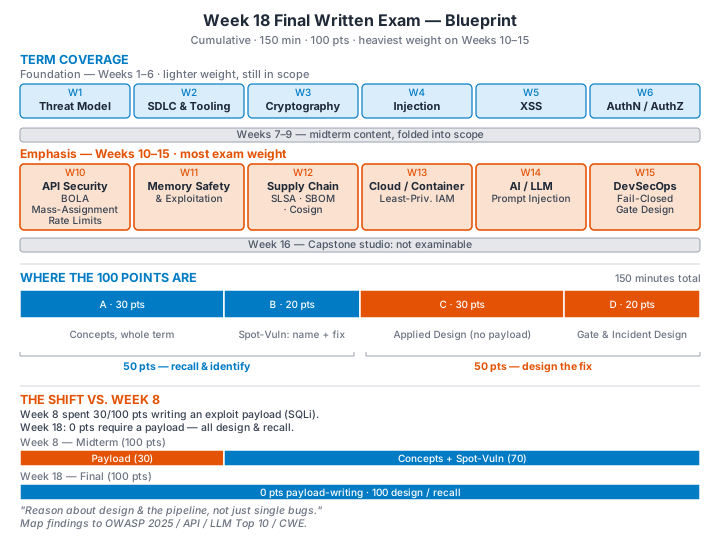
Course: Software Security (KOSEN69) · Cumulative, emphasis on Weeks 10–15 (Week 16 is the capstone studio — no new examinable content) Time: 150 min · Total: 100 pts
Name: ____________________ Student ID: ____________ Date: ________
Reason about design and the pipeline, not just single bugs. Map findings to OWASP 2025 / API / LLM Top 10 / CWE.
Section A — Modern-stack concepts (30 pts, 5 each)
A1. What is BOLA and why is it the #1 API risk? How does it differ from mass assignment? A2. Explain memory-safety mitigations (canary, ASLR, NX, PIE) and why memory-safe languages are the real fix. A3. Define SBOM, SLSA, and artifact signing — how they work together for supply-chain integrity. A4. What is security misconfiguration (A02)? Give three concrete cloud/container examples. A5. Explain direct vs indirect prompt injection with an example of each. A6. What does a CI security gate check, and what condition should fail the build?
Section B — Spot the Vulnerability (20 pts, 5 each)
Name it (+ OWASP/CWE) and give the fix.
B1.
@app.get("/api/users/<id>/orders")
def orders(id): return db.orders_for(id)   # any caller, any id
B2.
FROM ubuntu:latest
ENV AWS_SECRET=AKIA...
USER root
B3.
reply = llm(system_prompt + user_input)
return f"<div>{reply}</div>"   # rendered as HTML
B4.
char buf[64];
strcpy(buf, argv[1]);   // no bounds check
Section C — Applied (30 pts, 10 each)
C1. Design the fix for the BOLA endpoint in B1: show the authorization check and explain deny-by-default. C2. You ship a container image. Write the steps + tools to: scan it, generate an SBOM, sign it, and verify the signature before deploy. C3. An LLM feature lets users ask questions over uploaded documents (RAG) and can call a "send email" tool. List three risks (with LLM IDs) and a mitigation for each.
Section D — Design & DevSecOps (20 pts, 10 each)
D1. Design a GitHub Actions security pipeline: which scanners, what each catches, where SARIF goes, and the gate condition. Why "fail closed"? D2. Pick one notable supply-chain incident (e.g. XZ Utils, SolarWinds, Log4Shell) and explain the attack path and two controls that would have reduced impact.
End of exam. Pair with the Week 19 capstone CTF + project demos.